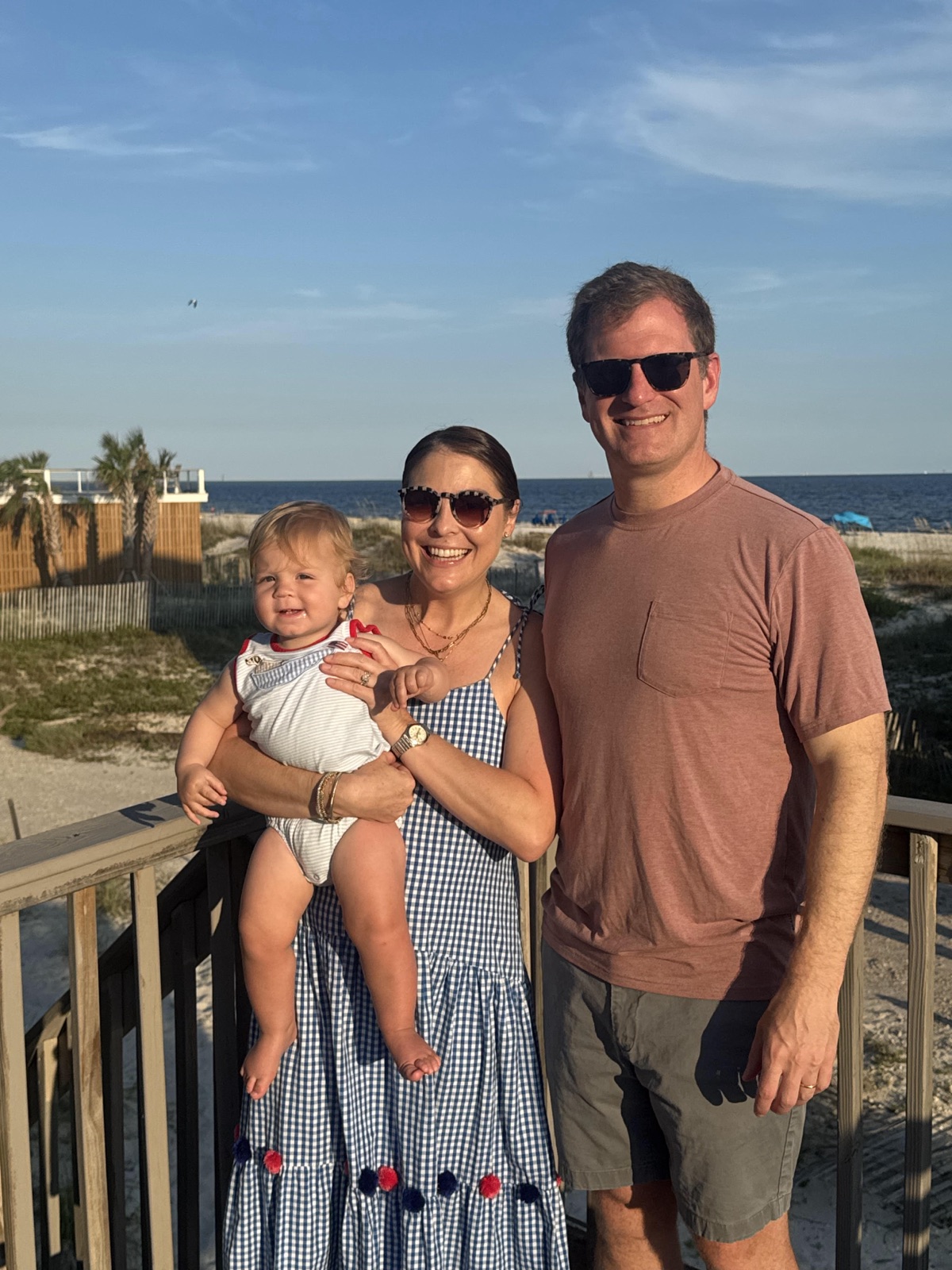
01 / The family
A family searching for answers
The Frost family knew they wanted to grow their family, but, due to their unfortunate circumstances, were unsure that they could safely do so.
Three years ago, they lost their infant son in the NICU due to an unexplained lung disease. His genome had been sequenced. Clinical lab specialists reviewed the results. The case was eventually referred to one of the world’s leading experts in rare developmental lung disorders. Sadly, the answers they were searching for never came.
Without a diagnosis, the parents had no way of knowing whether their son’s illness had been a random, singular tragedy or something hidden within their own DNA that could happen again.
They turned to IVF, hoping genetic testing could reduce that risk, but without a known mutation to test for, the best decision they could make was with incomplete information.
In a research study with Baylor College of Medicine, Gamow Labs researchers reanalyzed the genome using an AI tool. They found a hidden genetic clue that clinicians confirmed for their diagnosis.
02 / The challenge
Genome sequencing often represents hope.
Today, patients in the NICU that are critically ill can have their entire genome sequenced in a matter of days. But translating the three billion letters into an explanation for why a child is suffering, and giving families actionable information, remains out of reach for many.
All of these factors culminate in families not having answers when they need them.
At Gamow Labs, our hypothesis is straightforward: properly designed AI agents can help clinicians and researchers analyze genomes faster, more consistently, and at a scale that would be impossible through manual review alone.
We are not in the business of replacing geneticists. We want to make expert-level genomic interpretation available to every family, regardless of where they receive care.
03 / The study
Testing George on 26 challenging cases
To test whether that vision could work in practice, we partnered with Dr. Pawel Stankiewicz at Baylor College of Medicine, one of the world's leading experts in developmental lung disorders.
In a blinded study, his team provided deidentified whole genome sequences from 26 infants with interstitial lung disease whose diagnoses had been missed by first-line clinical laboratories and were then escalated to Dr. Stankiewicz. Dr. Stankiewicz’s lab subsequently solved 19/26, leaving 7 as mysteries.
A new look at the same 26 genomes
Each square represents one case in the blinded cohort.
“These are some of the most challenging cases in genomic medicine,” said Dr. Stankiewicz. “The patients had already undergone genome sequencing and clinical review, yet their diagnoses remained elusive. Solving these cases often requires looking beyond the standard ways of analyzing a genome and considering evidence from across the genome and the scientific literature.”
Routine clinical software can only screen for expected patterns. With George-0.1, our research pipeline using frontier models like Gemini 4 Argon, our researchers cross-referenced raw sequencing data against medical papers. This helped surface candidate variants and supporting evidence for clinicians to review. Specialized agents examine different forms of evidence, search the literature, and assemble candidate molecular findings supported by traceable evidence for clinical review.
Using this tool across the blinded study, our researchers matched the previously solved 19 cases. They also flagged candidate variants in 2 unsolved cases for Dr. Stankiewicz’s lab to validate. The Frost family's son was one of those two.
04 / The finding
Finding the hidden rearrangement
We found clusters of discordant read pairs along with split reads spanning the predicted breakpoint junctions, suggesting a balanced translocation in Baby Frost’s genome: a rearrangement in which a piece of DNA breaks off and reattaches somewhere else. In this case, this rearrangement would separate the FOXF1 enhancer from the FOXF1 gene, which would reduce FOXF1 expression to a lethal level and support the previous diagnosis of alveolar capillary dysplasia (ACD), a rare developmental disorder that prevents a newborn's lungs from supplying oxygen to the body.
A balanced translocation exchanges chromosome segments
01 Before the exchange
The enhancer and FOXF1 gene start on the same chromosome, on opposite sides of the breakpoint. Dashed lines mark the breaks.
02 After the exchange
The enhancer stays on derivative A. The FOXF1 gene moves with segment A2 to derivative B, separating the gene from its enhancer.
Because this kind of evidence can be artifactual in short-read whole genome sequencing, this hypothesis was confirmed with Sanger sequencing in Dr. Stankiewicz’s lab. After confirmation, the case was considered solved. Using Argon, researchers also identified why routine clinical software missed this rearrangement for so long; among other issues, annotation bugs mistakenly flagged it as common and filtered it out.
05 / The answer
What an answer meant for the Frost family
After validating our findings, Dr. Stankiewicz shared, “I think the most exciting possibility is that tools like this could give clinicians a faster path to genomic interpretation. For critically ill newborns, time matters. Access to our expertise can be limited. So having that capability available at scale could be a major shift for neonatal medicine.”
Dr. Stankiewicz confirmed the findings and shared his diagnosis with the Frost family.
“This information was an incredible gift,” said Randall Frost. “It didn’t undo our loss, but it gave my wife and I closure and the confidence to move forward in growing our family.”
We hope that delivering answers to the Frost family is just the beginning. Previous work has shown that re-analysis like this consistently reveals new diagnoses due to better tools, models, and science, and scaled AI-based approaches make this easier than ever before.