Gamow Labs has developed a high-throughput RNA-sequencing platform to understand how perturbations — genetic or chemical — affect cell state. As a proof of concept at Gamow, we screened 2,371 small-molecule compounds, about 1,000 of them FDA-approved, in IMR-90 human lung fibroblasts. We sought to identify compounds that could be repurposed for use in idiopathic pulmonary fibrosis (IPF), a rare disease with high unmet medical need. In addition to recovering drugs already used or tested in IPF, we found evidence that common hydrophobic statins can reverse the IPF gene expression signature in lung fibroblasts.
RNA sequencing (RNA-seq) shows what a compound does to a cell, meaning how gene expression changes in response to the drug. But it is too slow and expensive for screening thousands of compounds. GRETA is far faster than traditional RNA-seq and costs 20–40× less per sample (Table 1). Gamow’s wet lab automates the process from start to finish. In this experiment we ran 14 384-well plates and obtained 5,077 transcriptomes for under $20,000. The experiment took a fraction of the time traditional RNA-seq would have needed.
GRETA costs 20–40× less per sample than standard RNA-seq
| Per sample | Standard RNA-seq | GRETA |
|---|---|---|
| RNA extraction | ~$5–15 | None (direct lysis) |
| Library prep | ~$40–100one library per sample | ~$1–3one library per 384 wells |
| Sequencing | ~$15–4020–30M reads | ~$1–3~2M reads |
| Total per sample | ~$70–150 | $3.72actual cost |
| This screen (5,077 samples) | ~$360,000–760,000 | ~$19,000actual: 5,077 × $3.72 |
| Libraries to build | 5,077 | 14 |
| Hands-on time | Months | Days |
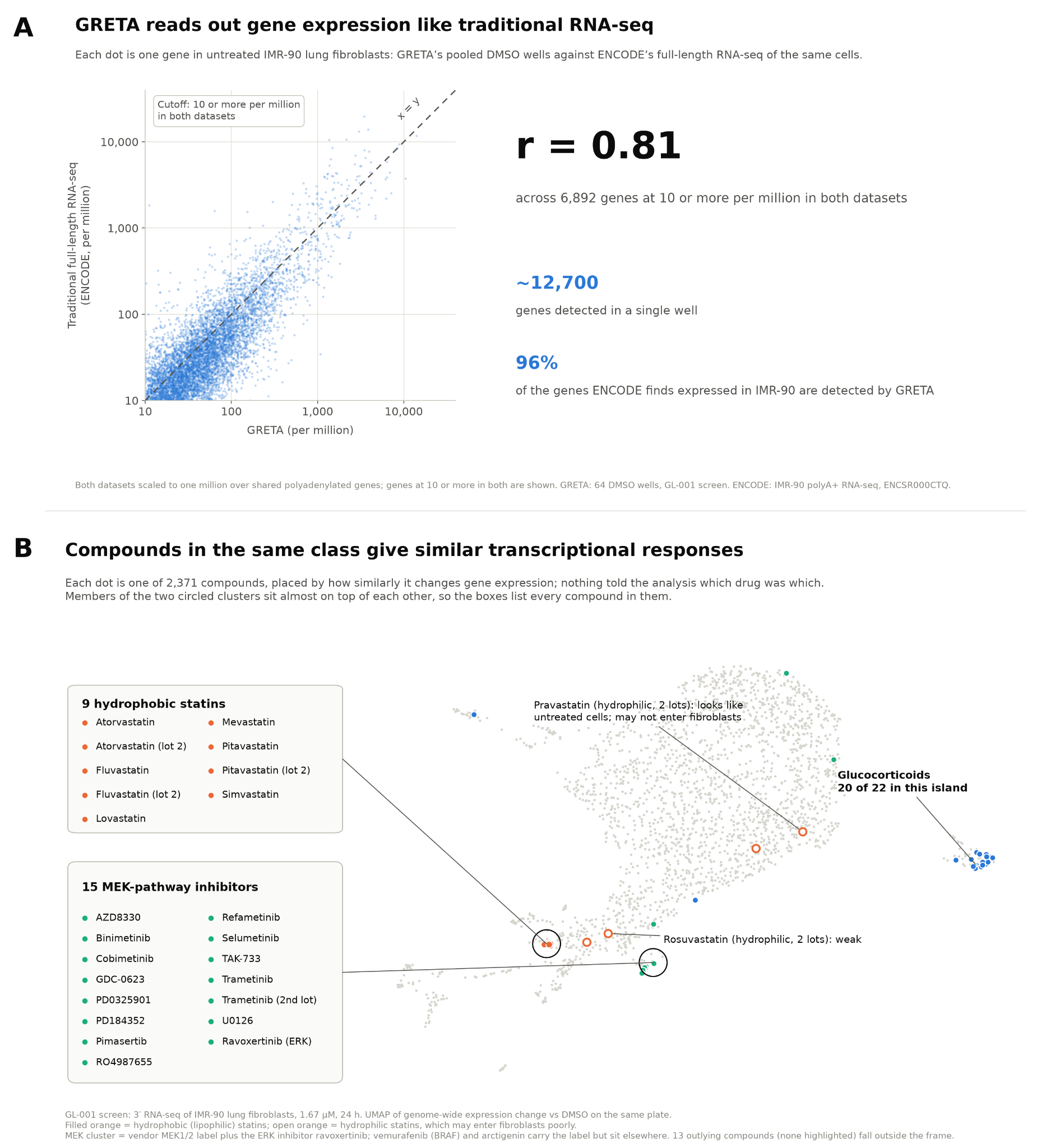
To check that GRETA reproduces the results of traditional RNA-seq, we compared our untreated (DMSO) samples with a published RNA-seq dataset from the same cells (ENCODE¹). Gene expression levels in the two datasets were closely correlated (r = 0.81; Figure 1A). GRETA also captures the biological effects of drug treatment. For example, when we map every compound’s effect on gene expression, drugs that share a target or pathway group together: glucocorticoids, MEK inhibitors and statins each formed their own cluster (Figure 1B). The map was built without any information about what the compounds were. These results show that GRETA can measure the effects of thousands of perturbations on cell state in a single experiment.
GRETA points to statins as a potential treatment for IPF
With this dataset in hand, we asked whether any approved drugs might help a disease they aren’t currently used for. Because the screen was run in IMR-90 lung fibroblasts, we focused on lung diseases.
Idiopathic pulmonary fibrosis (IPF) is a good test case. It is well studied, and the genes that change in IPF fibroblasts are well-documented from comparisons of diseased and healthy tissue. We searched for compounds that reverse an IPF gene expression signature: 200 genes that differ between fibroblasts cultured from IPF patients and from healthy lungs, combined from three published studies²⁻⁴.
Reassuringly, the screen picked out drugs already used or tested in IPF (Figure 2A):
- Nintedanib, one of three drugs approved for IPF, modestly reversed the signature.
- Dasatinib, omipalisib and saracatinib have each been tested in IPF patients, and they gave some of the strongest reversals in the screen. Dasatinib’s three lots ranked first, second and third of all 2,371 compounds.
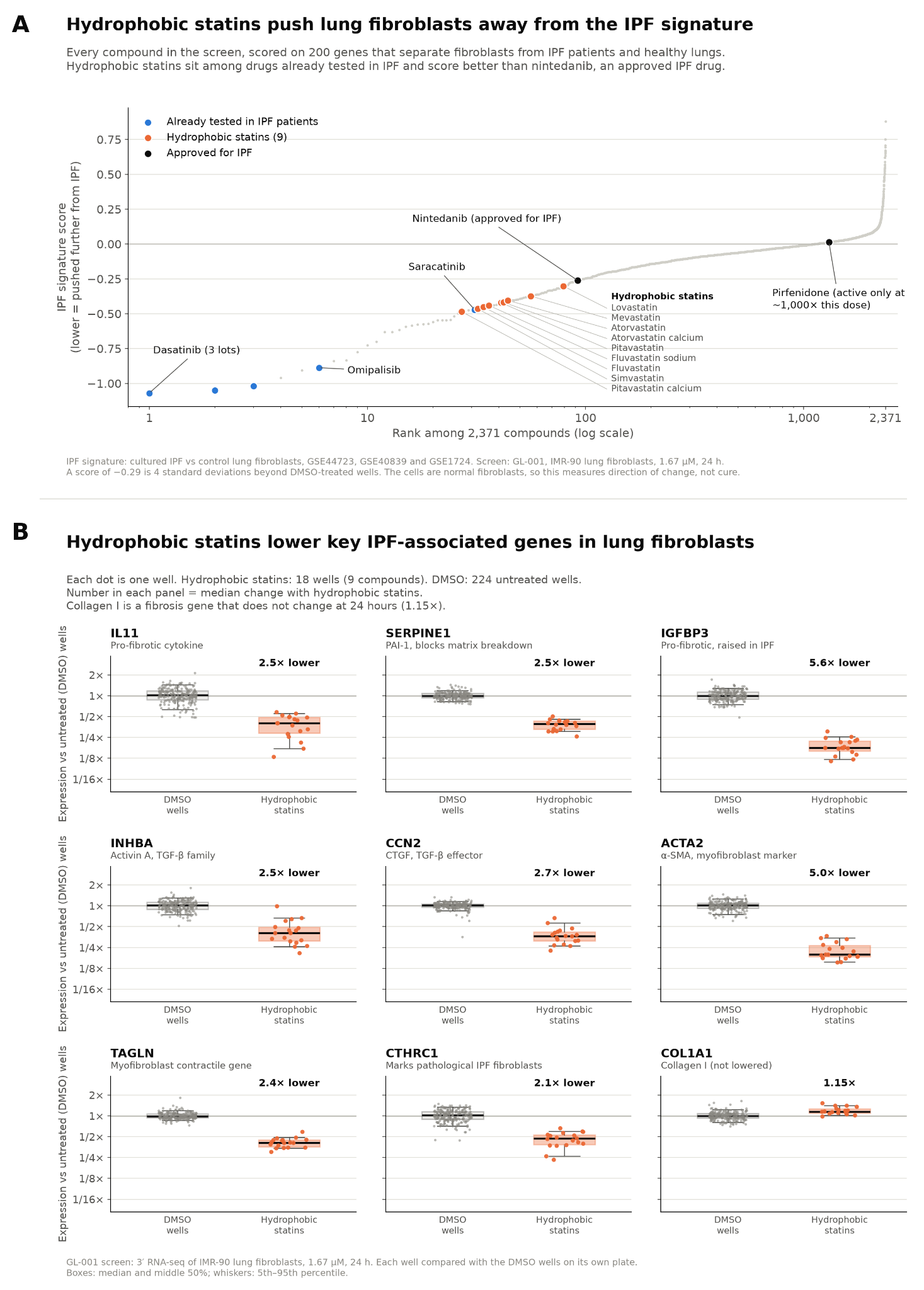
Notably, a second class of drugs also stood out: statins. All nine hydrophobic statins in the library reversed the IPF signature. Each dot in Figure 2B is one well treated with a statin, and in nearly every well statins lowered key drivers of fibrosis 2–6-fold. These include ACTA2 (α-smooth muscle actin, a myofibroblast marker), IGFBP3, CCN2 (CTGF), IL11 and SERPINE1.
Some clinical data are consistent with this result. A study of patients in the placebo groups of three pirfenidone trials compared patients who were already taking statins with those who were not⁵. Statin users had a lower risk of:
- IPF-related death;
- respiratory hospitalization;
- all-cause hospitalization.
That analysis was observational and could not tell whether statins act on the lung itself. Our data suggest they could act directly on lung fibroblasts, and others have seen similar effects: simvastatin reduced CTGF and α-smooth muscle actin in lung fibroblasts, including IMR-90⁶.
We believe GRETA can find drugs that could be repurposed for rare diseases, where treatment options are often limited. If you’d like access to this dataset, or want to explore how GRETA could help with a particular disease, please contact tim@gamowlabs.com.
References
- Djebali S, et al. Landscape of transcription in human cells. Nature 2012;489:101–108. doi:10.1038/nature11233. Data: ENCODE IMR-90 polyA+ RNA-seq, ENCSR000CTQ.
- Peng R, et al. Bleomycin induces molecular changes directly relevant to idiopathic pulmonary fibrosis: a model for “active” disease. PLoS One 2013;8:e59348. doi:10.1371/journal.pone.0059348. GEO: GSE44723.
- Lindahl GE, et al. Microarray profiling reveals suppressed interferon stimulated gene program in fibroblasts from scleroderma-associated interstitial lung disease. Respir Res 2013;14:80. doi:10.1186/1465-9921-14-80. GEO: GSE40839.
- Renzoni EA, et al. Gene expression profiling reveals novel TGFβ targets in adult lung fibroblasts. Respir Res 2004;5:24. doi:10.1186/1465-9921-5-24. GEO: GSE1724.
- Kreuter M, et al. Effect of statins on disease-related outcomes in patients with idiopathic pulmonary fibrosis. Thorax 2017;72:148–153. doi:10.1136/thoraxjnl-2016-208819.
- Watts KL, et al. Simvastatin inhibits growth factor expression and modulates profibrogenic markers in lung fibroblasts. Am J Respir Cell Mol Biol 2005;32:290–300. doi:10.1165/rcmb.2004-0127OC.