01 / The hackathon
A real case, shared with the research community
This year, Hugging Face, the MVA Society, Sage Bionetworks, BEACON, Anthropic, and AWS came together to launch the Rare Disease, Real Kid: MVA Hackathon 2026. The challenge centers on a child living with Mosaic Variegated Aneuploidy (MVA), an ultra-rare genetic condition. The patient’s family shared the genomic and clinical data with the research community in the hope of finding answers.
At Gamow Labs, we saw this as an opportunity to put our tools to work on a real case and contribute to a research effort that could help this family. We wanted to understand the genetic cause of the disease and then explore what we might be able to do about it.
02 / Track 1
First, finding the likely cause
Before we started looking for drugs, we first had to understand what might be causing this child’s disease. For our Track 1 submission, we used George, Gamow Labs’ variant interpretation system, to analyze the child’s genome alongside the clinical information provided for the hackathon. Within an hour of downloading the files, we had submitted the first correct answer on the leaderboard, earning a perfect score.
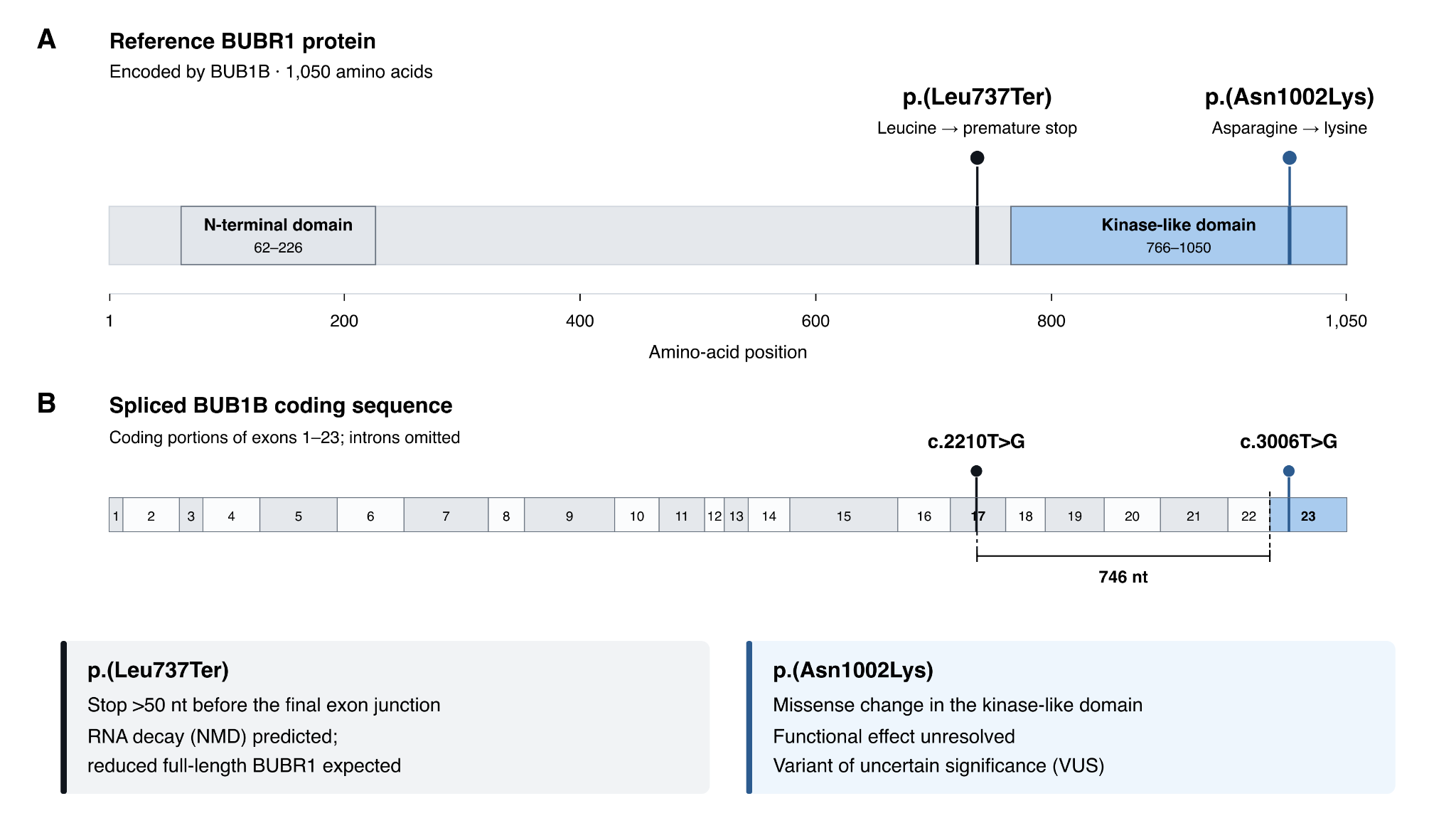
Our analysis pointed to two rare variants in BUB1B, the gene that encodes BUBR1. One introduces a premature stop and is predicted to prevent production of the full-length protein. The other changes a single amino acid, but we don’t yet know what that does to the protein’s function. We also still need to confirm that the variants are on opposite copies of the gene. Regardless, this gave us a starting point for Track 2.
03 / Track 2
Could an existing drug raise BUBR1?
For our Track 2 submission, we asked: could an existing drug be used to increase expression of BUB1B and thus the abundance of BUBR1 protein? One of the patient’s BUB1B variants introduces a premature stop and is predicted to reduce production of full-length BUBR1. There is literature evidence from cell culture models that aneuploidy severity tracks with the abundance of BUBR1 protein. If the two variants are on opposite alleles, the missense allele may provide the remaining full-length BUBR1. Whether that protein retains enough function for increased expression to help remains an open question.
04 / Public data
Starting with public data
We started with the LINCS 2020 L1000 gene expression dataset, ranking 1,188 drugs across 219 cell lines by their effects on BUB1B expression. We got a list of hits, but quickly realized a caveat with this type of bulk dataset. BUB1B expression is heavily correlated with the cell cycle, as it is involved in mitotic spindle formation. The ranking favored many compounds with broad effects on cell division and gene expression, including microtubule-targeting drugs like colchicine and ixabepilone, the proteasome inhibitor bortezomib, and the topoisomerase inhibitor idarubicin. This made these apparent hits difficult to interpret. Additionally, L1000 is not a sequencing-based readout. It is a Luminex bead assay, more akin to a microarray, and there are only 978 directly measured genes. The remaining 11,350 genes are inferred rather than directly measured. This made it hard to accept that any drug that raises BUB1B is always going to be linked to the cell cycle.
05 / Our screen
Running our own screen
At Gamow Labs, we’re fortunate to have the tools to follow up on questions like this ourselves. So we put our platform to work screening for compounds that increase BUB1B expression. For this, we used our high-throughput RNA-seq platform, GRETA, to profile approximately 2,400 compounds that are either FDA approved or have reached a clinical trial. We opted to use IMR90 cells, a primary fetal lung fibroblast line, for this screen. While not the perfect model, we thought that this would be a better model for this effort than an immortalized cancer cell line.
Measured, not inferred
Genes per expression profile, to scale.
11,350 inferred
average per treatment
| LINCS L1000 | GRETA | |
|---|---|---|
| Readout | Luminex bead assay | RNA-seq |
| Compounds | 1,188 drugs | ≈2,400 FDA-approved or clinical-stage |
| Cells | 219 cell lines | IMR90 primary fetal lung fibroblasts |
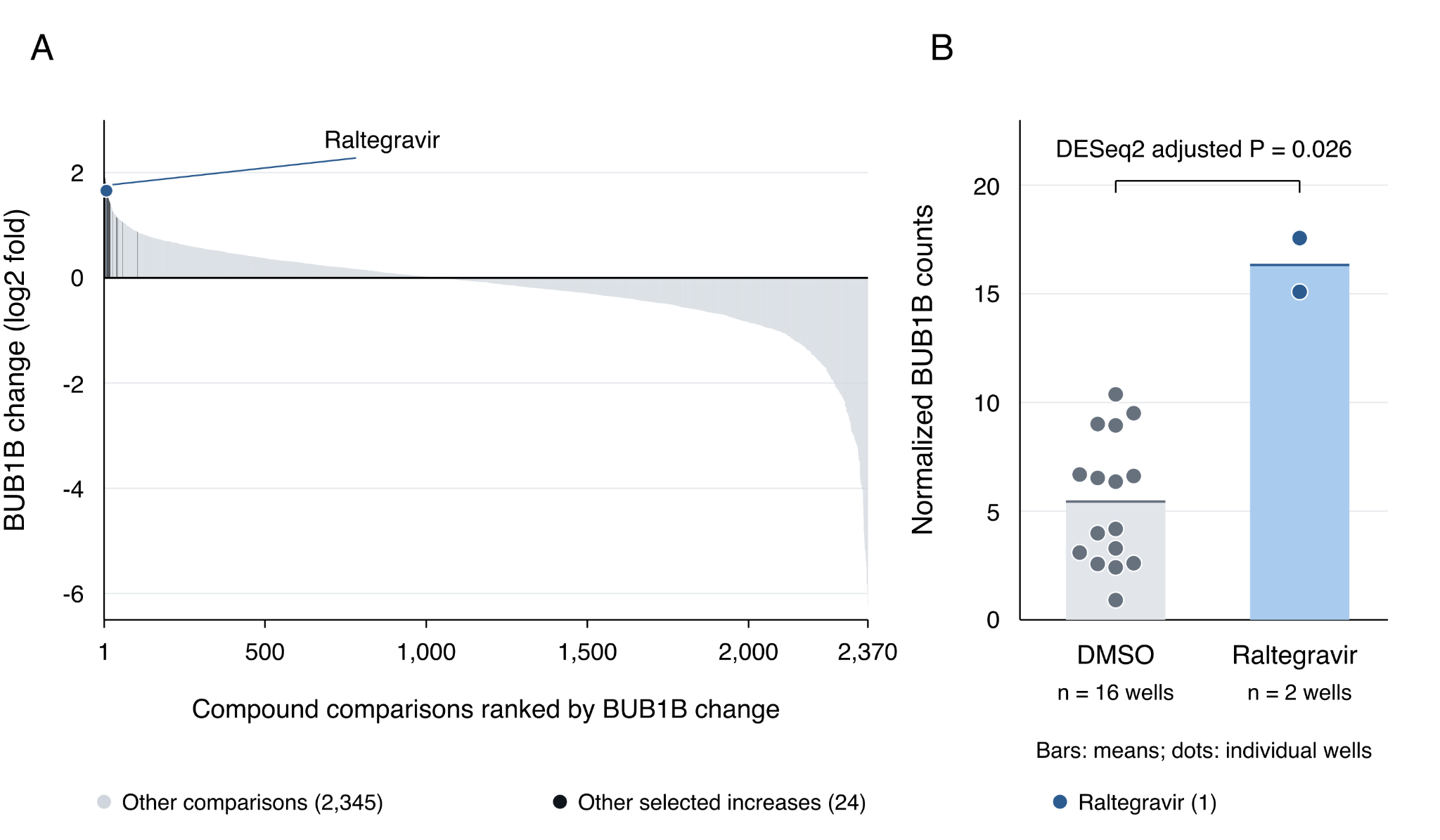
We grew the cells in-house, dosed and prepared the RNA-seq libraries on our automated platform, and immediately got to work analyzing the sequencing data (approximately 1 Tb of compressed FASTQ files) once we received it. Within 48 hours of receiving the data, we found 25 compounds that significantly increased BUB1B RNA (DESeq2 log2 fold change > 0, adjusted p-value < 0.05; adjusted across genes within each compound comparison) (Figure 2). As in our L1000 analysis, many of these are considered toxic cancer drugs that a clinician would likely not prescribe to a patient with MVA1. However, one of them, raltegravir (log2 fold change = 1.66, adjusted p-value = 0.026), is a compound used to treat HIV and has been shown to be relatively safe over long dosing regimens.
The caveat
The only caveat with our screen, however, is the same one that we saw with our L1000 analysis. All of our hit compounds show a large effect on the cell cycle: if BUB1B expression increases, so do many other genes linked to cell cycle arrest. This is not necessarily a deal breaker though, especially for a “safe” drug like raltegravir, but it is important to note this caveat as it will directly apply to any drug screen that relies on a bulk cell assay, whether it is RNA-seq or proteomics.
The next step for raltegravir or any of these other hits is to repeat this experiment, either in a high-throughput format like GRETA or in traditional RNA-seq, with multiple doses and time points to assess the specificity of the BUB1B expression response. Additionally, measuring BUBR1 protein after drug treatment via proteomics would inform how specific the response is, and using FACS to quantify the fraction of cells in each phase of the cell cycle will directly read out on how much cell cycle arrest these drugs do in fact cause.
06 / The dataset
An open dataset
The benefit of our dataset over the published L1000 dataset is the richness of information obtained. On average, each one of our approximately 2,400 treatments yielded 10,000 directly measured genes in a “healthy” lung fibroblast line. We know that we have only scratched the surface of this particular dataset, so if anyone either in the MVA1 community or the broader research community as a whole wants to use this dataset, please let us know.
Additionally, for the purposes of rare diseases like MVA1, our only true limitation is on the cell model front. We know that there are better cell models out there for many of these diseases. Gamow Labs has the potential to repeat this screen in just about any cell line, and we’re always looking for collaborators with patient-derived iPSCs or expertise in gene correction for running high-throughput screens like this.
07 / Beyond drugs
Beyond drug repurposing
These results also got us thinking about ways to restore functional BUBR1 beyond drug repurposing. One idea we discussed in our submission is to deliver BUB1B mRNA, giving cells instructions to make a working copy of the protein. Lipid nanoparticles could provide a way to carry that mRNA into cells, building on preclinical work on mRNA delivery. The challenge is figuring out which cells would benefit most, getting the mRNA into those cells, and controlling how much protein they produce. We would then need to show that this actually improves chromosome segregation in models of MVA1. There’s a lot of work between that idea and a treatment, but we think it’s worth exploring. We’re grateful to Kerna Labs for helping us think through the possibilities and challenges of an mRNA approach.
We would like to thank the MVA Society and all associated parties for hosting this hackathon, and the patient’s family for sharing their case with the research community. We’re thankful we were able to contribute and we hope that our data and ideas, alongside the work of the other teams, give the Society and broader MVA community something useful to build on. While there is still a lot to learn about this disease, we hope this effort brings us a little closer to answers for this patient and other families affected by MVA.